If you want the single best NLP course in 2026, take the free NLP Course from Hugging Face: it is the most practical hands-on path into modern transformers, written by the people who maintain the library most of the industry actually uses. It is aimed at engineers who already know Python and basic deep learning and want to fine-tune and ship models rather than study theory. Natural language processing now spans two worlds, the classical toolchain (tokenization, TF-IDF, word vectors, named-entity recognition) and the transformer era (BERT, attention, large language models), and no single course covers both perfectly. So below we rank seven courses we have independently reviewed, spanning free and paid, beginner-friendly to advanced, and we are honest about where each one falls short. If you are brand new to programming, start with a Python or intro-deep-learning course first, then come back to this list.
How we picked
These picks come from our independent editorial reviews of 200+ AI courses in the Cursarium catalog. For each course we read the current public syllabus, checked who teaches it and their credentials, weighed real learner feedback and aggregate ratings (Class Central, provider pages, and community discussion), and verified pricing and recency against primary sources. We deliberately rank a course lower when it is dated, when its code no longer runs cleanly, or when its marketing oversells what it teaches, and we say so plainly. We did not accept any payment for placement, and where we could not independently confirm a rating, we left it out rather than repeat an unverified number. Every recommendation links to the course in our catalog and, where relevant, to our deeper natural language processing topic guide.
The best NLP courses
1. NLP Course — Hugging Face
This free, open-source course (formerly the "NLP Course," now expanded into LLM topics) ranks first because it is the canonical, first-party guide to the Transformers ecosystem, written and maintained by the Hugging Face team itself, including core maintainers and the authors of O'Reilly's "Natural Language Processing with Transformers." Its real strength is that it is genuinely hands-on: every section runs in Google Colab, and you actually fine-tune models, push them to the Hub, and build Gradio demos rather than just read theory. The honest caveat is that it is not a beginner course, the official page assumes good Python and recommends finishing an intro deep-learning course first, and there is currently no certificate (Hugging Face says certification is "in the works"). It is 100% free with no ads, intermediate level, and independent reviews put it around 4.5/5 on Class Central. If you can clear the prerequisites, the cost-to-value ratio is hard to beat: NLP Course.
2. Natural Language Processing Specialization — Coursera
DeepLearning.AI's four-course specialization is the best structured, breadth-first path through NLP, taking you from classical methods (Naive Bayes, word vectors, hidden Markov models) up to attention and transformer architectures like T5 and the Reformer. It earns a 4.6/5 from roughly 6,194 reviews and is taught by credible instructors, including Łukasz Kaiser, a co-author of the "Attention Is All You Need" transformer paper. Its genuine weakness, echoed consistently by reviewers, is uneven lab quality: many programming assignments are guided "fill-in-the-blank" tasks, so you can earn a perfect score without fully grasping the material, meaning you need extra independent practice to reach real mastery. (Note: the labs migrated from Trax to TensorFlow in December 2023, so older complaints about Trax are outdated.) It is paid via a Coursera subscription (about $49/month, first course auditable free) and intermediate level, assuming Python, ML basics, and some linear algebra and calculus. A strong, graduate-style survey if you have the prerequisites: Natural Language Processing Specialization.
3. Modern Natural Language Processing in Python — Udemy
This Lazy Programmer course (live on Udemy as "[2026] Machine Learning: Natural Language Processing (V2)") holds an excellent 4.8/5 across roughly 6,900-7,200 ratings, and we rank it third for its breadth and build-it-yourself rigor. Its real strength is exceptional, code-first coverage: a genuine "four-in-one" spanning text-to-vector models (CountVectorizer, TF-IDF, word2vec, GloVe), probabilistic and Markov models, classic ML tasks (spam detection, sentiment, latent semantic analysis), and a deep-learning block ending with a Hugging Face Transformers section. The honest caveat is that it is mis-framed for transformers: despite the catalog title and topic tags, transformers are only one applied Hugging Face section, not a from-scratch deep dive into attention, BERT, or GPT internals, so pick a transformer-specific course if that architecture is your sole goal. It is a paid, one-time Udemy purchase (around $12.99 in our catalog, list price is largely promotional) at intermediate level, with lifetime access and a certificate. A superb NLP fundamentals course: Modern Natural Language Processing in Python.
4. NLP - Natural Language Processing with Transformers in Python — Udemy
James Briggs' course is our pick when your specific goal is applied, BERT-style transformer projects. Across roughly 11 hours it is highly project-based, culminating in two complete builds, a financial-Reddit sentiment analyzer and an open-domain question-answering system, using the classic transformer stack of Hugging Face, TensorFlow, PyTorch, spaCy, and Haystack. The instructor is a credible NLP specialist (ex-Pinecone developer advocate, founder of Aurelio AI), and it holds a verified 4.5/5 from about 2,820 ratings. The honest caveat is currency: it was last updated in September 2024 and centers on the pre-generative-AI workflow (BERT/DPR, retriever-reader QA), so it does not cover modern LLM or RAG tooling, and some older TensorFlow/Haystack code can need dependency fixes to run today. It is paid (around $12.99 on Udemy, frequently discounted) at intermediate level, with a certificate of completion. Treat it as a strong foundation in encoder-style transformers, not a current LLM course: NLP - Natural Language Processing with Transformers in Python.
5. Introduction to Natural Language Processing in Python — DataCamp
If you want the fastest path to solid classical NLP fundamentals, this tight four-hour, browser-based course is our pick. Taught by Katharine Jarmul (founder of kjamistan), its strength is the learn-by-doing format: about 52 in-browser coding exercises with instant feedback, no setup, building up to a tangible capstone, a working "fake news" text classifier. It rates 4.7/5 from roughly 971-981 learners on DataCamp's own page. The important caveat is recency: it is built entirely on NLTK, Gensim, spaCy, and scikit-learn with zero coverage of transformers, embeddings, or Hugging Face, and DataCamp has since reorganized its NLP track to lead with a newer transformer-inclusive course instead. It is paid via a DataCamp subscription (about $25/month; only the first chapter is free) at intermediate level, assuming prior Python, with a shareable Statement of Accomplishment. A great foundations primer, as long as you pair it with transformer material afterward: Introduction to Natural Language Processing in Python.
6. Natural Language Processing — Kaggle
Kaggle Learn's free, three-lesson micro-course is our pick for a zero-cost, two-to-four-hour first taste of applied NLP with spaCy. Its strength is how concrete and fast it is: every lesson is built around a real Yelp-reviews business scenario (tokenization and pattern matching, a bag-of-words text classifier, and word vectors fed into a LinearSVC reaching roughly 94% accuracy), it runs entirely in Kaggle's in-browser notebooks, and it ends with a free shareable certificate. The honest caveat is that the lesson code was written for spaCy v2 and uses deprecated APIs, so the classification and training notebooks do not run as-written on modern spaCy 3.x without edits, and it teaches none of the transformer or LLM methods that dominate NLP in 2026. It is free and intermediate level (it does assume Python and basic ML despite the short length); we could not independently verify an aggregate star rating, so we are not quoting one. A solid, free primer before you move to transformers: Natural Language Processing.
7. A Code-First Introduction to NLP — fast.ai
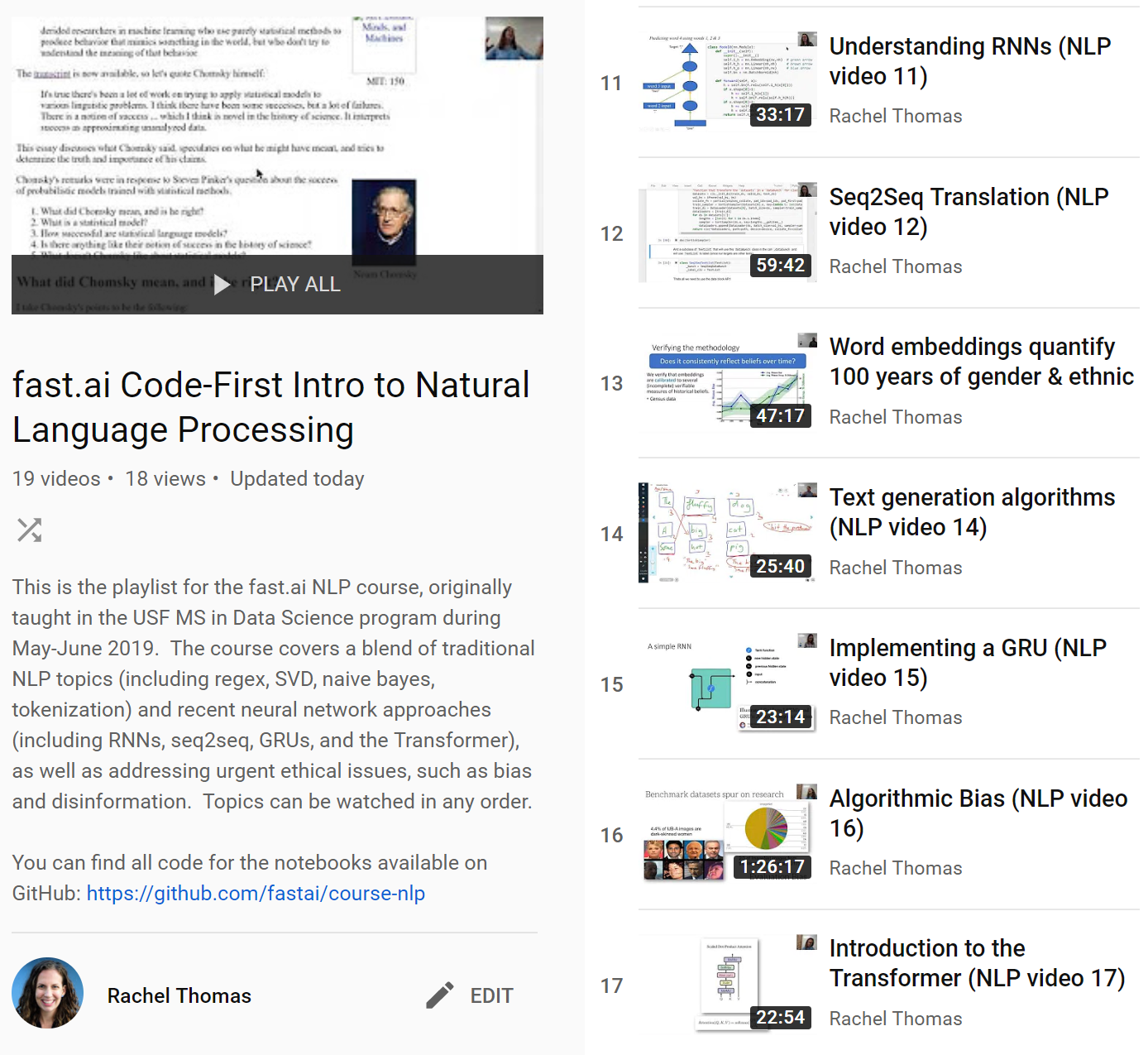
fast.ai's free video course, taught by Rachel Thomas with guest lessons from Jeremy Howard, rounds out the list for learners who want to understand NLP from the ground up. Its strength is the full conceptual arc plus something genuinely rare: it moves from classical methods (SVD/NMF topic modeling, Naive Bayes, regex) through RNNs, seq2seq translation, ULMFiT, and the Transformer, then closes with substantive lessons on algorithmic bias and disinformation that almost no other technical course includes. The honest caveat is age: it was recorded in mid-2019 on the fastai v1 API (a non-compatible predecessor to v2), so the notebooks frequently break on current libraries and stop well before today's LLM and RAG workflows, you will get the most value watching it for concepts while implementing in your own stack. It is free and intermediate level, with no certificate and no aggregate rating we could verify (the course-nlp GitHub repo has roughly 3,477 stars as a popularity signal). Best used as a conceptual and historical base, not a current production playbook: A Code-First Introduction to NLP.
How to choose
There is no universally "best" NLP course, only the best one for your background and goal. Use this quick guide to match yourself to a pick:
- You already know Python and basic deep learning and want to ship transformer models: start with the free NLP Course from Hugging Face.
- You want a structured, graduate-style survey with a certificate and don't mind paying: take the Natural Language Processing Specialization, and budget extra independent practice because the labs hand-hold.
- You want deep, build-from-scratch fundamentals across classical and deep-learning NLP in one course: choose Modern Natural Language Processing in Python, knowing transformers are only one applied section.
- Your goal is concrete BERT-style transformer projects (sentiment, QA): take NLP with Transformers in Python, but expect pre-LLM, 2024-era tooling.
- You're short on time and want classical fundamentals fast: do the four-hour Introduction to NLP in Python or the free Kaggle NLP micro-course, then move on to transformers.
- You're a complete beginner: do a Python and intro-deep-learning course first, then return to this list, none of these is a true first programming course.
- You want the rigorous academic theory behind attention and transformers: see our review of Stanford's CS224N, an advanced, math-heavy alternative to these applied courses.
- Watch the price on subscription and bootcamp options (Coursera, DataCamp, and the pricier Udacity NLP Nanodegree): finishing faster lowers cost, and discounts are common, so rarely pay full sticker price.
Frequently Asked Questions
Which NLP course is best for beginners in 2026?
None of these is a true first-programming course; each assumes Python. The gentlest on-ramps are the free Kaggle NLP micro-course and DataCamp's four-hour Introduction to NLP, both classical and hands-on. Learn Python and basic machine learning first, then take one of those before attempting the transformer-focused Hugging Face course.
Are free NLP courses good enough, or should I pay?
Free options are genuinely excellent. The Hugging Face course is first-party and current, Kaggle and fast.ai are solid, and you can learn real NLP without spending anything. You mainly pay for structure, graded feedback, and a recognized certificate, which is what the Coursera, DataCamp, and Udemy paid options add.
Do these courses cover transformers, BERT, and large language models?
It varies, and we are explicit per course. Hugging Face covers modern transformers and LLM fine-tuning; Coursera reaches attention and transformer architectures; the two Udemy courses cover BERT-style and applied transformers. Kaggle, DataCamp, and fast.ai are mostly classical NLP, with fast.ai reaching the Transformer conceptually but predating today's LLMs.
Will I get a certificate?
Depends on the course. Coursera, DataCamp, Kaggle, and the two Udemy courses provide certificates or statements of accomplishment. The Hugging Face course and fast.ai course currently do not, Hugging Face says certification is "in the works." For most hiring, a portfolio of real NLP projects matters more than any single certificate.
How long do these NLP courses take to finish?
It ranges widely. Kaggle is about 2-4 hours and DataCamp roughly 4 hours; the Udemy courses run 11 to 25 hours of video. The Hugging Face course is realistically 60-90+ hours across 12 chapters, fast.ai is several weeks part-time, and the Coursera specialization is about three months at 10 hours per week.