
Intermediate AI Courses
Intermediate AI courses are where theory meets practice. At this level, you already understand the basics of machine learning and are ready to deepen your expertise. These courses cover topics like neural network architectures, transformer models, reinforcement learning, and production ML workflows. You will work with industry-standard frameworks such as PyTorch and TensorFlow, and tackle real-world datasets. Whether you want to specialize in NLP, computer vision, or MLOps, intermediate courses bridge the gap between foundational knowledge and the skills needed for professional AI roles.
All Intermediate Courses

Machine Learning
Stanford Online

Deep Learning Specialization
Coursera

NLP Course
Hugging Face

Generative AI with Large Language Models
Coursera
LangChain for LLM Application Development
DeepLearning.AI

Deep Reinforcement Learning Course
Hugging Face

Machine Learning Scientist with Python
DataCamp
Building Systems with the ChatGPT API
DeepLearning.AI

Natural Language Processing Specialization
Coursera

TensorFlow Developer Professional Certificate
Coursera

Google Advanced Data Analytics Professional Certificate
Coursera

IBM AI Engineering Professional Certificate
Coursera

Generative Adversarial Networks (GANs) Specialization
Coursera

Machine Learning
edX

Artificial Intelligence
edX

Machine Learning with Python: from Linear Models to Deep Learning
edX
Principles of Machine Learning
edX

Data Science: Machine Learning
edX

Deep Learning A-Z 2024: Neural Networks, AI & ChatGPT
Udemy

NLP - Natural Language Processing with Transformers in Python
Udemy

LangChain Masterclass - Build 15 LLM Apps with LangChain
Udemy

PyTorch for Deep Learning & Machine Learning
Udemy

TensorFlow Developer Certificate in 2024: Zero to Mastery
Udemy

Generative AI, LLMs - OpenAI API, LangChain, Hugging Face
Udemy

Deep Learning and Computer Vision A-Z: OpenCV, SSD & GANs
Udemy
Finetuning Large Language Models
DeepLearning.AI
LangChain: Chat with Your Data
DeepLearning.AI
AI Agents in LangGraph
DeepLearning.AI
Vector Databases: from Embeddings to Applications
DeepLearning.AI
Quality and Safety for LLM Applications
DeepLearning.AI
Building and Evaluating Advanced RAG Applications
DeepLearning.AI
How Diffusion Models Work
DeepLearning.AI
Preprocessing Unstructured Data for LLM Applications
DeepLearning.AI
Knowledge Graphs for RAG
DeepLearning.AI
Building Multimodal Search and RAG
DeepLearning.AI
Automated Testing for LLMOps
DeepLearning.AI
Build an LLM App with LangChain.js
DeepLearning.AI
Computational Linear Algebra
fast.ai
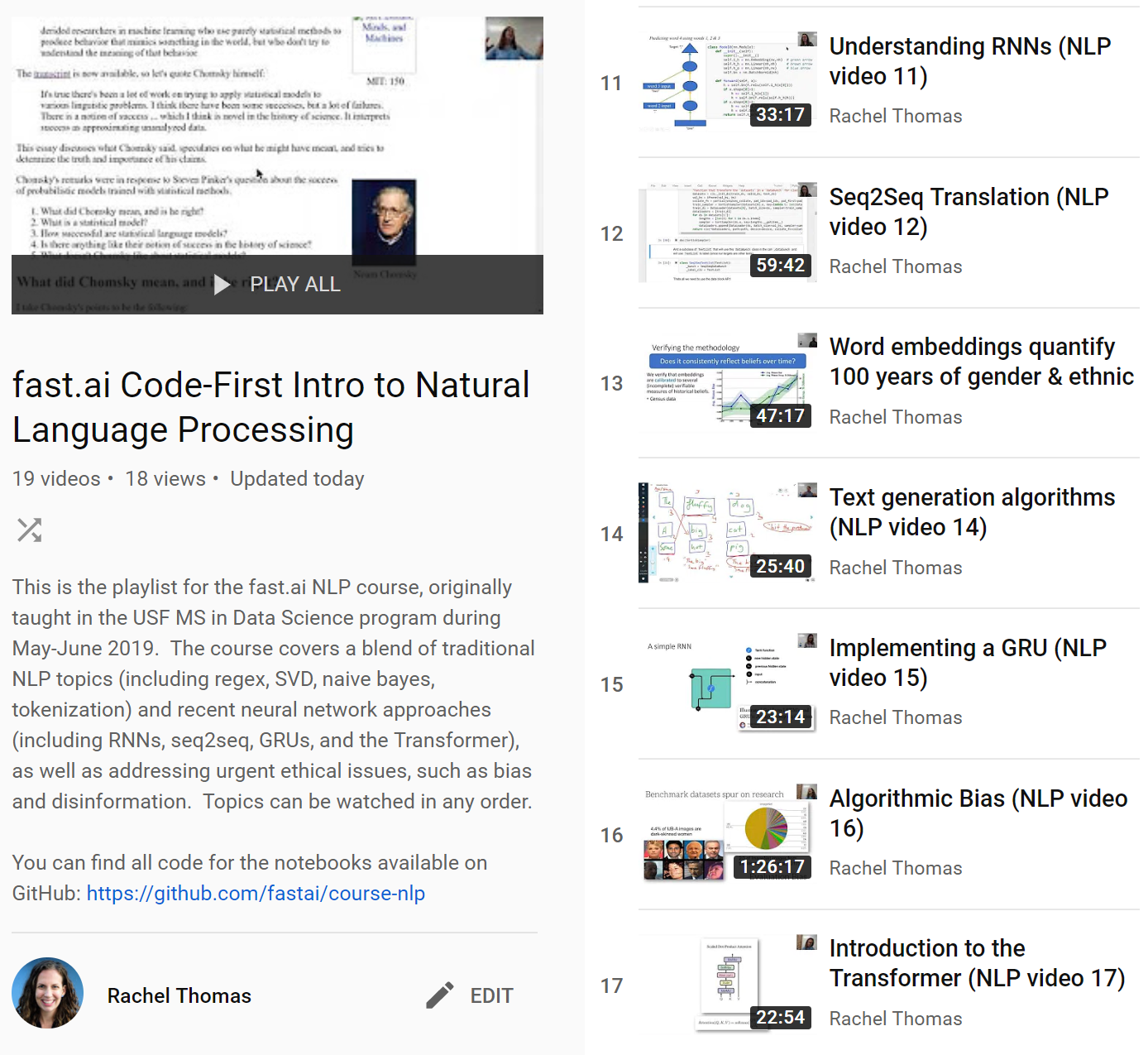
A Code-First Introduction to NLP
fast.ai
Deep Learning
Stanford Online
Introduction to Machine Learning
MIT OpenCourseWare
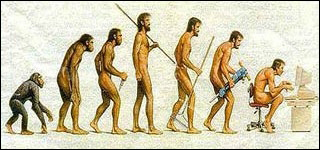
Artificial Intelligence
MIT OpenCourseWare

Intermediate Machine Learning
Kaggle
Feature Engineering
Kaggle
Natural Language Processing
Kaggle
Computer Vision
Kaggle
Time Series
Kaggle

Diffusion Models Course
Hugging Face

Audio Course
Hugging Face

Azure AI Engineer Associate
Microsoft Learn
Azure Data Scientist Associate
Microsoft Learn
Natural Language Processing Nanodegree
Udacity

Computer Vision Nanodegree
Udacity

Deep Learning in Python
DataCamp

Introduction to Natural Language Processing in Python
DataCamp
Unsupervised Learning in Python
DataCamp

Image Processing in Python
DataCamp

NLP with Python for Machine Learning Essential Training
LinkedIn Learning
AI Agents & RAG: Build 10 Real AI Agent Apps with LangChain
Udemy

AWS Certified Machine Learning Specialty 2024
Udemy
Functions, Tools and Agents with LangChain
DeepLearning.AI
Large Language Models with Semantic Search
DeepLearning.AI
Quantization Fundamentals with Hugging Face
DeepLearning.AI

Serverless LLM Apps with Amazon Bedrock
DeepLearning.AI
The Analytics Edge
edX
Advanced SQL
Kaggle
Intro to Game AI and Reinforcement Learning
Kaggle

Building AI Agents with Hugging Face
Hugging Face

Data Scientist Nanodegree
Udacity
Introduction to Deep Learning with PyTorch
DataCamp
Building Event-Driven Generative AI Applications
DeepLearning.AI
MLOps Essentials: Model Deployment and Monitoring
LinkedIn Learning
Introduction to Reinforcement Learning
DataCamp

Generative AI Nanodegree
Udacity

Extreme Gradient Boosting with XGBoost
DataCamp

Complete Generative AI Course With Langchain and Huggingface
Udemy

Linear Algebra
MIT OpenCourseWare
Geospatial Analysis
Kaggle

Professional Certificate in Data Science
edX
Computer Vision: Deep Learning with Python
LinkedIn Learning

End-to-End Machine Learning with MLflow
Udemy

AI for Medicine Specialization
Coursera

IBM Generative AI Engineering Professional Certificate
Coursera

Google Data Engineering Professional Certificate
Coursera

Modern Natural Language Processing in Python
Udemy
Multi AI Agent Systems with crewAI
DeepLearning.AI
Machine Learning Fundamentals
edX

Introduction to Vertex AI
Google Cloud

Python for Time Series Data Analysis
Udemy

Deep Neural Networks with PyTorch
Coursera
Introduction to Computer Vision
edX

Feature Engineering for Machine Learning
Udemy
Introduction to On-Device AI
DeepLearning.AI

Open-Source AI Cookbook
Hugging Face

Preprocessing for Machine Learning in Python
DataCamp
LangChain Essential Training
LinkedIn Learning

Deep Learning for Computer Vision with TensorFlow
Coursera
Probability - The Science of Uncertainty and Data
edX
LLMOps
DeepLearning.AI
Introduction to LLMs in Python
DataCamp
PyTorch Essential Training: Deep Learning
LinkedIn Learning
Building with the Claude API
Anthropic
Claude Code in Action
Anthropic
Introduction to Model Context Protocol
Anthropic
Machine Learning with Python
freeCodeCamp
Applied AI Foundations (OpenAI Academy)
OpenAI
What to Expect at the Intermediate Level
- Assumes familiarity with basic ML concepts and Python
- Deeper dives into specific algorithms and architectures
- Projects using real-world datasets and scenarios
- Introduction to specialized frameworks and tools
- More mathematical rigor and theory
Recommended Learning Path
Choose a specialization area that aligns with your career goals, such as NLP, computer vision, or generative AI.
Complete a structured multi-course program like the Deep Learning Specialization or Hugging Face NLP Course.
Build a portfolio project that demonstrates your skills to potential employers or collaborators.
Frequently Asked Questions
What prior knowledge do I need for intermediate courses?
You should be comfortable with Python programming, basic linear algebra, and fundamental ML concepts like supervised vs. unsupervised learning, overfitting, and model evaluation. Completing at least one beginner course is recommended.
Are intermediate courses enough to land an AI job?
Intermediate courses provide strong technical foundations, but employers also value practical experience. Combine your coursework with personal projects, Kaggle competitions, or open-source contributions to build a compelling portfolio.
How do I choose between different intermediate courses?
Consider your target role and industry. If you want to work with language models, focus on NLP and LLM courses. If you are interested in autonomous systems, look at computer vision and reinforcement learning. Check course reviews and instructor backgrounds to find the best fit.