fast.ai vs Coursera
A detailed comparison of fast.ai and Coursera for AI and machine learning courses, covering course catalog, ratings, pricing, and certifications.
Our Verdict
fast.ai offers a free, opinionated, top-down approach that gets you training models from day one, while Coursera provides structured, university-backed programs with formal certificates. fast.ai is perfect for self-motivated hackers who learn by building, and Coursera suits those who prefer guided curricula and recognized credentials.
fast.ai vs Coursera: the details
fast.ai
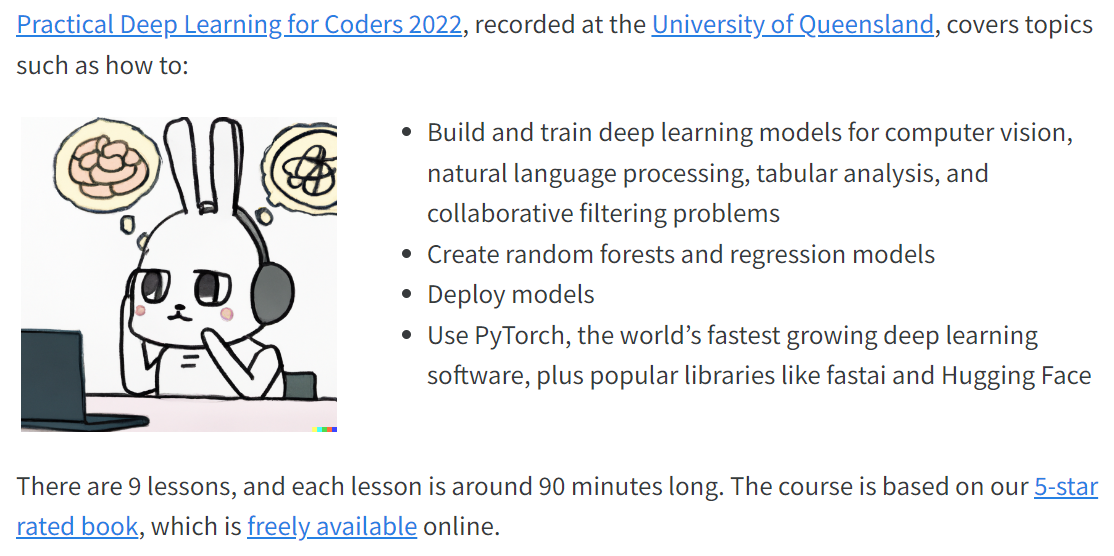
fast.ai is a non-profit deep learning research and education group founded in 2016 by Jeremy Howard (former President and Chief Scientist of Kaggle) and Rachel Thomas, with the stated goal of democratizing deep learning. Its flagship offering, the free 'Practical Deep Learning for Coders' MOOC, teaches a code-first, top-down approach using PyTorch, the fastai library, and Hugging Face, getting learners to train and deploy real models from the very first lesson. The course is entirely free with no paywalls or upsells, but it grants no certificate to online learners (only the original in-person University of San Francisco cohorts could earn one). fast.ai is widely regarded as one of the best hands-on deep learning resources available, while drawing consistent criticism for its thin theoretical/mathematical coverage and the heavy abstraction of its own fastai library.
Best for: Working programmers with roughly a year of Python experience who learn best by building. It suits people who want to train image classifiers, NLP models, and other deep learning applications quickly, deploy them early, and pick up the underlying theory incrementally rather than front-loading months of math.
Pricing: Free. The entire 'Practical Deep Learning for Coders' MOOC (Part 1 and Part 2) is available at no cost as recorded video lessons plus interactive notebooks, with no subscription, per-course fee, or audit/paywall split. The companion book 'Deep Learning for Coders with fastai & PyTorch' is sold separately but the notebooks behind it are also free.
Strengths
- Completely free with no paywalls, upsells, or paid tiers; all video lessons, Jupyter notebooks, pretrained models, datasets, and an active forum are open access (course.fast.ai).
- Code-first, top-down 'whole game' pedagogy gets learners training and deploying production models (image classification, NLP) in lesson 1, which Reddit and Class Central reviewers repeatedly cite as highly motivating.
- Taught by Jeremy Howard, who has ~30 years of ML experience and was the top-ranked global Kaggle competitor two years running, lending strong instructor credibility.
- Uses current, industry-relevant tooling (PyTorch, fastai, Hugging Face Transformers, Gradio) and minimal math prerequisites, introducing needed calculus/linear algebra as the course goes.
Weaknesses
- No certificate or formal credential for online learners; only the original in-person University of San Francisco classes could grant one.
- Theoretical and mathematical depth is thin by design; reviewers note it 'glazes over' concepts like backpropagation, often requiring outside study (e.g. Khan Academy) to keep up.
- Heavy reliance on the fastai library's high-level abstractions and terse, abbreviated variable names (e.g. ds_tfms, pat) can obscure what is happening underneath and hurts code readability for beginners.
Coursera
Coursera is the largest accredited online learning marketplace for AI and machine learning, hosting flagship programs from DeepLearning.AI (Andrew Ng), Stanford, IBM, Google, and Amazon Web Services rather than producing courses itself. Its anchor AI content is exceptionally well-reviewed: the DeepLearning.AI Deep Learning Specialization holds 4.8/5 across roughly 147,000 program reviews, and the non-technical AI For Everyone sits at 4.8/5 across more than 52,000 reviews. Access runs on a subscription model (Coursera Plus at $399/year or ~$59/month, with individual specializations $49-$79/month), and need-based financial aid grants full free access including the certificate to learners who cannot pay. The trade-off is that Coursera certificates are recognized but rarely decisive in hiring, and the most beginner-oriented AI courses are frequently criticized as too shallow for practitioners.
Best for: Beginners and career-switchers who want a structured, credentialed pathway into AI/ML taught by recognized authorities (Andrew Ng, Stanford, IBM, Google), learners who value graded hands-on labs in the browser, and anyone who qualifies for financial aid and wants a free certificate-bearing path. Also strong for working professionals who can finish a specialization inside a single subscription month and for non-technical staff needing AI literacy.
Pricing: Subscription-based with a real free tier via financial aid. Coursera Plus is about $59/month or $399/year (frequently discounted 40-50%, e.g. ~$199-$240 first year during promos) and bundles most specializations. Individual specializations are subscription-priced at roughly $49-$79/month; Professional Certificates (Google, IBM, Meta) and degrees are billed separately and are NOT included in Plus. Single non-specialization courses can be audited free without a certificate. Need-based financial aid, applied for per course, grants full free access including the certificate.
Strengths
- Best-in-class instructor and partner roster for AI: DeepLearning.AI / Andrew Ng, Stanford, IBM, Google, Imperial College London, and AWS, with the Deep Learning Specialization rated 4.8/5 over ~147,000 reviews and AI For Everyone 4.8/5 over 52,000+ reviews.
- Genuine free path via need-based financial aid: approved applicants get full course access plus the certificate at no cost (typically a 180-day window), and individual non-specialization courses can be audited free for lectures.
- Hands-on, graded learning rather than passive video: programming assignments run as in-browser Jupyter notebooks, and the GenAI with LLMs course (co-built with AWS, 4.8/5) includes real fine-tuning and RLHF labs.
- Accredited, university-backed catalog that scales up to full Master's degrees, giving a credible institutional brand and a coherent beginner-to-degree progression most competitors lack.
Weaknesses
- Beginner AI courses are widely criticized as oversimplified - reviewers cite quizzes with answers in the questions, copy-paste labs, thin math, and a lack of end-to-end projects, leaving some learners with only partial understanding.
- Certificate value is modest: hiring managers and Reddit/Blind/Class Central discussions consistently say Coursera certificates are recognized but treated as resume supplements, below degrees and demonstrated experience in competitive ML roles.
- Pricing friction and gating: specializations and Professional Certificates (Google, IBM, Meta) are excluded from or priced separately, individual specializations run $49-$79/month, and specializations cannot be audited for free - you must pay or get financial aid to do graded work.
Top Courses
Top from fast.ai
Practical Deep Learning for Coders
fast.ai

Practical Deep Learning for Coders Part 2: Deep Learning Foundations to Stable Diffusion
fast.ai
Computational Linear Algebra
fast.ai