

FSDL
Explore 1 courses from FSDL covering AI and machine learning.
About FSDL
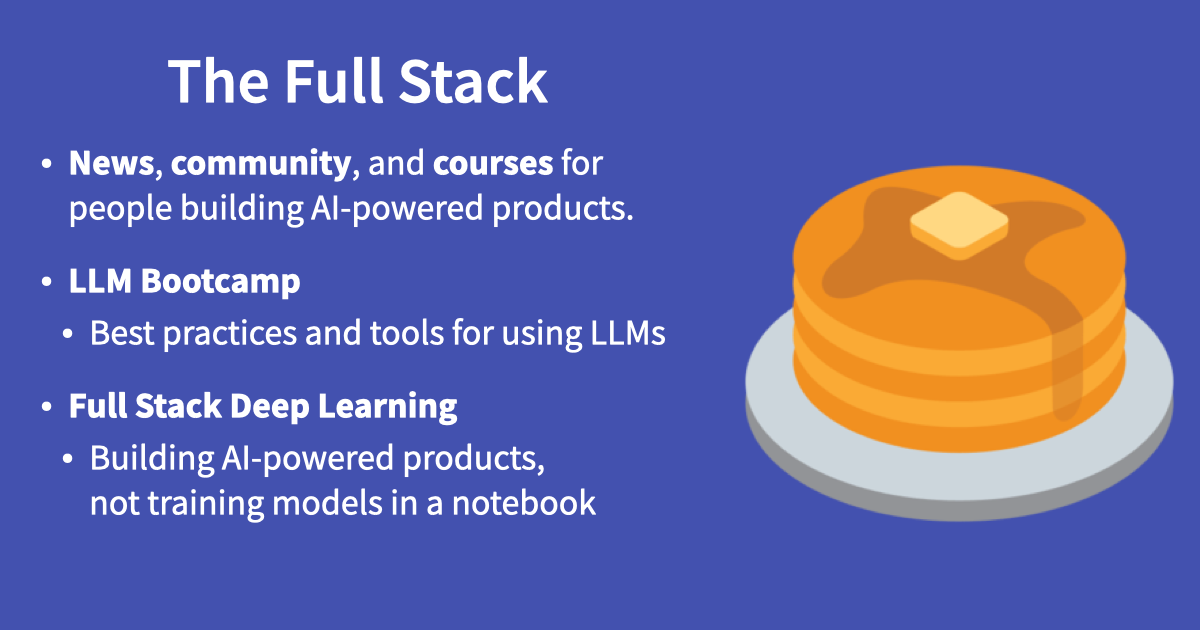
Full Stack Deep Learning (FSDL) is a free, production-focused program that teaches how to ship deep-learning and LLM systems rather than just train models, covering MLOps, deployment, data management, testing, monitoring, and continual learning. It was created by UC Berkeley PhDs Sergey Karayev (co-founder of Gradescope), Josh Tobin (former OpenAI research scientist), and Pieter Abbeel, with recent editions co-taught by Charles Frye. The catalog centers on the FSDL 2022 course (9 lectures, pre-labs on CNNs, Transformers and PyTorch Lightning, 8 hands-on labs and a capstone) and the 2023 LLM Bootcamp, with all lecture and lab material published openly on YouTube and GitHub. It is best understood as a practitioner bridge from 'I can train a model' to 'I can deploy and operate one,' not an introductory ML course.
Best for: Engineers and ML practitioners who already know the basics of deep learning (DNN architectures, training a model in PyTorch, Python) and want a practical, opinionated, end-to-end view of taking models to production — experiment tracking, testing, deployment as a web service, monitoring, and building LLM-powered apps with prompt engineering and LLMOps.
Look elsewhere if: Complete beginners to machine learning or those who need math/theory foundations, a structured cohort with grading and deadlines, or an accredited/verified certificate for HR screening. People who want hand-holding or a passive lecture-only experience will also struggle, since the value is concentrated in doing the labs and capstone.
Pricing: Free. All lecture videos, lab materials, slides, and source code are published at no cost (the site states lecture and lab material is 'free forever'), distributed via the website, YouTube, and GitHub. There is no subscription, per-course fee, or paid tier; live in-person bootcamp seats were the only historically paid/limited element, and those recordings are now free.
Certificates: Low as a formal credential. FSDL does not advertise an accredited or verifiable certificate of completion on its official course pages, so it should not be relied on for HR/ATS screening. Its real signaling value comes indirectly: completing the capstone or the LLM Bootcamp reference project gives a concrete, production-style portfolio piece, and the program is well regarded by ML practitioners, so naming it plus showing the project can carry weight in technical interviews even without a certificate.
Strengths
- Genuinely production-oriented curriculum that fills the gap most ML courses skip — deployment, data management, troubleshooting/testing, monitoring, and continual learning rather than just model architecture
- Taught by credible practitioners (UC Berkeley PhDs Karayev, Tobin, Abbeel, plus Charles Frye); Tobin was an OpenAI research scientist and Karayev co-founded Gradescope, so the advice reflects real shipping experience
- Completely free and openly published — lectures, lab code, slides, and the YouTube playlist are 'free forever,' with no paywall or subscription
- Hands-on by design: FSDL 2022 includes 8 labs and an end-to-end capstone, and the 2023 LLM Bootcamp ships a full reference project (askFSDL) covering retrieval, embeddings, and deployment
- Stays current with industry shifts — added a dedicated 2023 LLM Bootcamp (prompt engineering, LLMOps, augmented language models, UX for language interfaces) alongside the classic deep-learning track
Weaknesses
- No formal or verified certificate is offered on the official course pages, so it carries no standalone credential weight for employers — its value is the knowledge and portfolio project, not a line item on a resume
- Content is edition-dated (the flagship course is 2022 and the LLM Bootcamp is April 2023); tooling and model specifics in MLOps/LLMOps move fast, so some references will feel out of date
- Self-paced and largely self-directed now that cohorts have ended — no live grading, deadlines, or guaranteed instructor feedback, which means weaker completion for learners who need structure
- Assumes real prerequisites (deep-learning fundamentals and PyTorch); it is unforgiving for newcomers and does not teach ML from scratch
All Courses from FSDL
How we reviewed FSDL
Independent editorial overview based on FSDL's public course catalog and aggregated public learner feedback (last reviewed 2026-06).
- FSDL official site (home — free, AI-product focus)
- FSDL 2022 course (curriculum, labs, capstone, free-forever materials)
- FSDL LLM Bootcamp (prompt engineering, LLMOps, instructors, free recordings)
- KDnuggets — Free Full Stack LLM Bootcamp (independent coverage)
- Class Central — The Full Stack institution listing (free courses, no formal certificate)
- FSDL 2022 YouTube playlist (open lecture access)