
Best AI Courses for Academic Researchers
AI is accelerating the pace of discovery across every academic discipline, from computational biology and climate science to digital humanities and social research. Researchers who understand machine learning can design better experiments, analyze massive datasets, and uncover patterns that would be impossible to find manually. Whether you work in a wet lab, conduct field research, or study archives, these courses will give you the technical foundation to apply AI methods to your own research questions, critically evaluate AI-based findings in published literature, and collaborate effectively with data scientists and ML engineers.
Key AI Skills for Academic Researchers
- Apply machine learning methods to research datasets
- Use NLP tools for literature review and text analysis
- Design experiments that incorporate AI-powered analysis
- Evaluate statistical validity of AI-generated results
- Build reproducible ML pipelines for academic work
- Understand ethical considerations of AI in research
How to Start Learning AI as a Academic Researcher
Start with a machine learning fundamentals course like Andrew Ng's Machine Learning Specialization to build a strong conceptual and practical foundation (estimated 40-60 hours).
Take a hands-on Python data science course to learn how to preprocess, visualize, and analyze research data with libraries like pandas, scikit-learn, and matplotlib (estimated 20-30 hours).
Explore a deep learning or NLP course relevant to your field to learn how to apply state-of-the-art models to your specific research questions (estimated 30-40 hours).
Recommended Courses for Academic Researchers

Machine Learning
Stanford Online

Deep Learning Specialization
Coursera
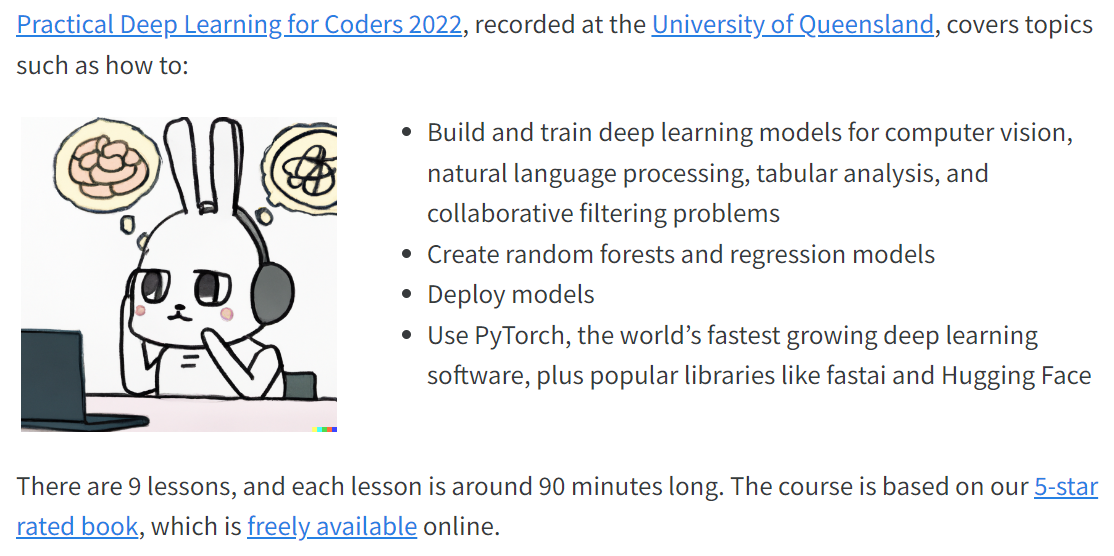
Practical Deep Learning for Coders
fast.ai

Introduction to Deep Learning
MIT

Machine Learning Crash Course

CS50's Introduction to Artificial Intelligence with Python
Harvard / edX

Intro to Deep Learning
Kaggle
Intro to Machine Learning with PyTorch
Udacity
Machine Learning Specialization
Coursera

Elements of AI
University of Helsinki

Deep Learning
NYU

Machine Learning Scientist with Python
DataCamp

AI For Everyone
Coursera

Google Data Analytics Professional Certificate
Coursera

Google Advanced Data Analytics Professional Certificate
Coursera

IBM AI Engineering Professional Certificate
Coursera

Generative Adversarial Networks (GANs) Specialization
Coursera

Mathematics for Machine Learning and Data Science Specialization
Coursera

MicroMasters in Statistics and Data Science
edX

Machine Learning
edX

Artificial Intelligence
edX

Machine Learning with Python: from Linear Models to Deep Learning
edX

Python Basics for Data Science
edX
Deep Learning Fundamentals with Keras
edX
Principles of Machine Learning
edX

Data Science: Machine Learning
edX

Machine Learning A-Z: AI, Python & R
Udemy

Python for Data Science and Machine Learning Bootcamp
Udemy

Deep Learning A-Z 2024: Neural Networks, AI & ChatGPT
Udemy

PyTorch for Deep Learning & Machine Learning
Udemy

TensorFlow Developer Certificate in 2024: Zero to Mastery
Udemy

Complete Machine Learning & Data Science Bootcamp 2024
Udemy

Deep Learning and Computer Vision A-Z: OpenCV, SSD & GANs
Udemy
How Diffusion Models Work
DeepLearning.AI

Practical Deep Learning for Coders Part 2: Deep Learning Foundations to Stable Diffusion
fast.ai
Deep Learning
Stanford Online
Deep Multi-Task and Meta Learning
Stanford Online
Introduction to Machine Learning
MIT OpenCourseWare
Artificial Intelligence
MIT OpenCourseWare

Machine Learning for Healthcare
MIT OpenCourseWare
Intro to TensorFlow for Deep Learning

Google Data Analytics Certificate

Google's Python Class
Intermediate Machine Learning
Kaggle
Feature Engineering
Kaggle
Time Series
Kaggle
Pandas
Kaggle
Data Visualization
Kaggle
Machine Learning for Beginners
Microsoft
AI for Beginners
Microsoft

Azure Data Scientist Associate
Microsoft Learn

Machine Learning with Python
Coursera

Introduction to Deep Learning & Neural Networks with Keras
Coursera

AI Programming with Python Nanodegree
Udacity

Deep Learning in Python
DataCamp
Data Scientist with Python Career Track
DataCamp

Artificial Intelligence Foundations: Machine Learning
LinkedIn Learning
Machine Learning with Python: Foundations
LinkedIn Learning
Deep Learning: Getting Started
LinkedIn Learning

Google Machine Learning Engineer Professional Certificate
Coursera

AWS Certified Machine Learning Specialty 2024
Udemy
Google Cloud: Introduction to AI and Machine Learning
edX
The Analytics Edge
edX
Intro to SQL
Kaggle
Advanced SQL
Kaggle
Python for Data Analysis with Pandas
LinkedIn Learning

IBM Data Science Professional Certificate
Coursera

Data Scientist Nanodegree
Udacity
Introduction to Deep Learning with PyTorch
DataCamp

How Google Does Machine Learning
Coursera

Introduction to TensorFlow for AI, ML, and DL
Coursera

The Data Science Course: Complete Data Science Bootcamp
Udemy
Data Science Essentials
edX
Machine Learning with Graphs
Stanford Online

Extreme Gradient Boosting with XGBoost
DataCamp
Geospatial Analysis
Kaggle

Professional Certificate in Data Science
edX
Computer Vision: Deep Learning with Python
LinkedIn Learning

AI for Medicine Specialization
Coursera

Google Data Engineering Professional Certificate
Coursera
Machine Learning Fundamentals
edX
Data Cleaning
Kaggle

Introduction to Vertex AI
Google Cloud

Bayesian Machine Learning in Python: A/B Testing
Udemy

Python for Time Series Data Analysis
Udemy
TensorFlow: Essential Training
LinkedIn Learning

Deep Neural Networks with PyTorch
Coursera

Feature Engineering for Machine Learning
Udemy
AWS Machine Learning Foundations
Udacity

Preprocessing for Machine Learning in Python
DataCamp
PyTorch Essential Training: Deep Learning
LinkedIn Learning
Machine Learning with Python
freeCodeCamp
Artificial Intelligence Fundamentals
IBM SkillsBuild
Frequently Asked Questions
Do I need programming experience to use AI in research?
Basic Python skills are very helpful and most courses teach them alongside AI concepts. Many researchers find that learning Python and ML together is more motivating because they can immediately apply new skills to their own datasets.
Which AI techniques are most useful for academic research?
It depends on your field. NLP is valuable for text-heavy disciplines, computer vision for image analysis, and traditional ML for structured data analysis. Start with the fundamentals and then specialize based on your research needs.
How can AI help with literature reviews?
AI tools can summarize papers, identify key themes across large corpora, find relevant citations, and extract structured data from published research. Learning prompt engineering and NLP basics will help you use these tools effectively.