
Best AI Courses for Developers
As a developer, adding AI and machine learning to your skill set opens up some of the most exciting and well-compensated career paths in tech. Whether you want to build intelligent applications, transition into an ML engineering role, or simply understand the AI systems you work alongside, these courses provide the technical depth you need. You will learn to implement neural networks from scratch, train models with PyTorch and TensorFlow, design production ML pipelines, and build applications powered by large language models. The courses below range from practical introductions for developers with no ML background to advanced programs covering state-of-the-art architectures and deployment strategies. Your existing programming skills give you a significant head start, and many of these courses are designed to leverage that advantage.
Key AI Skills for Developers
- Implement and train neural networks with PyTorch and TensorFlow
- Build end-to-end ML pipelines from data to deployment
- Fine-tune and deploy large language models
- Design scalable AI-powered applications
- Apply best practices for model testing and monitoring
- Understand transformer architectures and attention mechanisms
How to Start Learning AI as a Developer
Start with a hands-on course like fast.ai Practical Deep Learning or Google ML Crash Course that builds on your existing coding skills.
Deepen your understanding with a specialization like the Deep Learning Specialization, covering CNNs, RNNs, and modern architectures.
Gain production skills by studying MLOps, model deployment, and building LLM-powered applications with tools like LangChain.
Recommended Courses for Developers

Machine Learning
Stanford Online

Deep Learning Specialization
Coursera
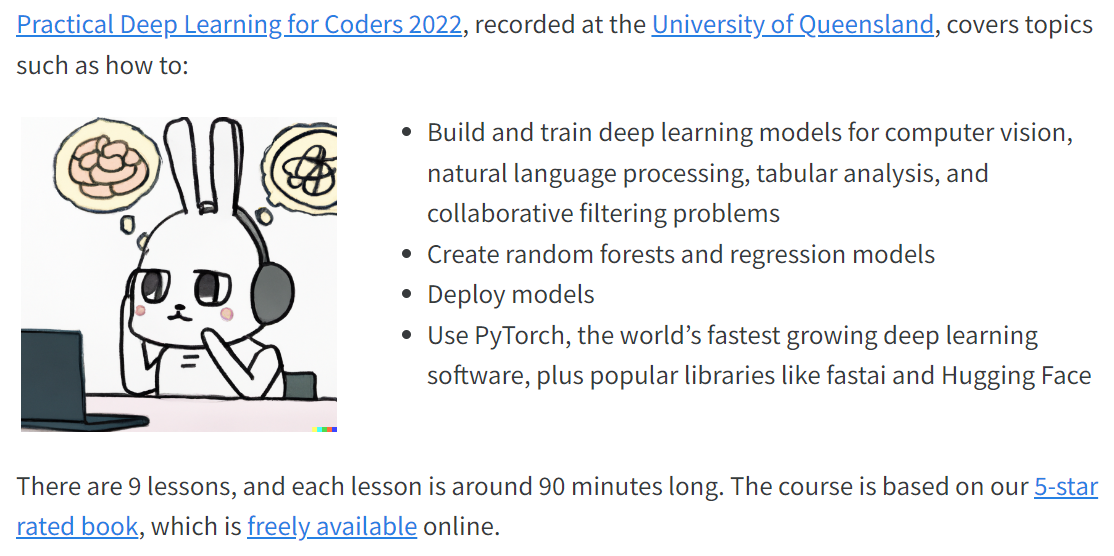
Practical Deep Learning for Coders
fast.ai

Introduction to Deep Learning
MIT

Machine Learning Crash Course

CS50's Introduction to Artificial Intelligence with Python
Harvard / edX

Intro to Deep Learning
Kaggle
Intro to Machine Learning with PyTorch
Udacity
Machine Learning Specialization
Coursera

Elements of AI
University of Helsinki

Deep Learning
NYU

Machine Learning Scientist with Python
DataCamp

AI For Everyone
Coursera

TensorFlow Developer Professional Certificate
Coursera

Google Advanced Data Analytics Professional Certificate
Coursera

IBM AI Engineering Professional Certificate
Coursera

Generative Adversarial Networks (GANs) Specialization
Coursera

Mathematics for Machine Learning and Data Science Specialization
Coursera

MicroMasters in Statistics and Data Science
edX

Machine Learning
edX

Artificial Intelligence
edX

Machine Learning with Python: from Linear Models to Deep Learning
edX

Deep Learning Fundamentals with Keras
edX
Principles of Machine Learning
edX

Data Science: Machine Learning
edX

Machine Learning A-Z: AI, Python & R
Udemy

Python for Data Science and Machine Learning Bootcamp
Udemy

Deep Learning A-Z 2024: Neural Networks, AI & ChatGPT
Udemy

PyTorch for Deep Learning & Machine Learning
Udemy

TensorFlow Developer Certificate in 2024: Zero to Mastery
Udemy

Complete Machine Learning & Data Science Bootcamp 2024
Udemy

Deep Learning and Computer Vision A-Z: OpenCV, SSD & GANs
Udemy
How Diffusion Models Work
DeepLearning.AI

Practical Deep Learning for Coders Part 2: Deep Learning Foundations to Stable Diffusion
fast.ai
Deep Learning
Stanford Online
Deep Multi-Task and Meta Learning
Stanford Online
Introduction to Machine Learning
MIT OpenCourseWare
Artificial Intelligence
MIT OpenCourseWare

Machine Learning for Healthcare
MIT OpenCourseWare
Intro to TensorFlow for Deep Learning
Intermediate Machine Learning
Kaggle
Feature Engineering
Kaggle
Time Series
Kaggle
Machine Learning for Beginners
Microsoft
AI for Beginners
Microsoft

Azure Data Scientist Associate
Microsoft Learn

Machine Learning with Python
Coursera

Introduction to Deep Learning & Neural Networks with Keras
Coursera

AI Programming with Python Nanodegree
Udacity

Deep Reinforcement Learning Nanodegree
Udacity

Computer Vision Nanodegree
Udacity

Deep Learning in Python
DataCamp
Data Scientist with Python Career Track
DataCamp

Artificial Intelligence Foundations: Machine Learning
LinkedIn Learning
Machine Learning with Python: Foundations
LinkedIn Learning
Deep Learning: Getting Started
LinkedIn Learning

Google Machine Learning Engineer Professional Certificate
Coursera

AWS Certified Machine Learning Specialty 2024
Udemy
Google Cloud: Introduction to AI and Machine Learning
edX

IBM Data Science Professional Certificate
Coursera

Data Scientist Nanodegree
Udacity
Introduction to Deep Learning with PyTorch
DataCamp

How Google Does Machine Learning
Coursera

Introduction to TensorFlow for AI, ML, and DL
Coursera

The Data Science Course: Complete Data Science Bootcamp
Udemy
Machine Learning with Graphs
Stanford Online

Extreme Gradient Boosting with XGBoost
DataCamp

Professional Certificate in Data Science
edX
Computer Vision: Deep Learning with Python
LinkedIn Learning

AI for Medicine Specialization
Coursera
Machine Learning Fundamentals
edX
Introduction to Vertex AI
Google Cloud

Bayesian Machine Learning in Python: A/B Testing
Udemy

Python for Time Series Data Analysis
Udemy
TensorFlow: Essential Training
LinkedIn Learning

Deep Neural Networks with PyTorch
Coursera

Feature Engineering for Machine Learning
Udemy
AWS Machine Learning Foundations
Udacity

Preprocessing for Machine Learning in Python
DataCamp

Deep Learning for Computer Vision with TensorFlow
Coursera
PyTorch Essential Training: Deep Learning
LinkedIn Learning
Machine Learning with Python
freeCodeCamp
Artificial Intelligence Fundamentals
IBM SkillsBuild
Frequently Asked Questions
How much math do developers need for AI?
Practical ML courses focus on intuition and code over proofs. You need comfort with basic linear algebra and calculus, but many courses teach the required math as you go. As you advance, more mathematical depth becomes valuable.
Should I learn PyTorch or TensorFlow first?
PyTorch has become the preferred framework in research and increasingly in industry. However, TensorFlow remains widely used in production. Start with PyTorch for flexibility, then learn TensorFlow for deployment-specific needs.
How long does it take for a developer to become an ML engineer?
With consistent study, a developer can build strong ML skills in 3-6 months. Completing a specialization plus building 2-3 portfolio projects is a solid path to an ML engineering role.
What is the best way to practice AI skills?
Kaggle competitions, personal projects, and contributing to open-source ML libraries are excellent ways to practice. Building real applications that solve problems you care about is the most effective learning strategy.